What Is HDR Blending in Real Estate Photography? A Complete Guide
If you’ve ever looked at a real estate listing photo and wondered how the interior looks perfectly lit and the view through the window looks crystal clear at the same time, the answer is HDR blending. It’s one of the most important techniques in professional real estate photo editing, and at EditMeUp, it’s a service we deliver every day for agents and photographers around the world.
Here’s everything you need to know about how it works, what we need from you, and what’s actually possible.
What Is HDR Blending?
HDR (High Dynamic Range) blending is the process of combining multiple photos of the same scene, each captured at a different exposure, into a single image that holds detail in both the brightest and darkest areas.
A camera sensor simply can’t capture everything a room offers in one shot. In a typical interior, it struggles to hold onto:
- The bright view outside the windows
- The interior shadows
- The ceiling lights
- The darker corners of a room
That’s why photographers shoot several bracketed exposures of the same composition, and we blend them together into one natural, balanced final image.
What We Need From You: Bracketed Exposures
The gold standard for HDR blending is a bracketed set — multiple shots of the exact same scene at different exposures, with nothing in the frame moving between shots.
The most common setup is a 3-photo bracket:
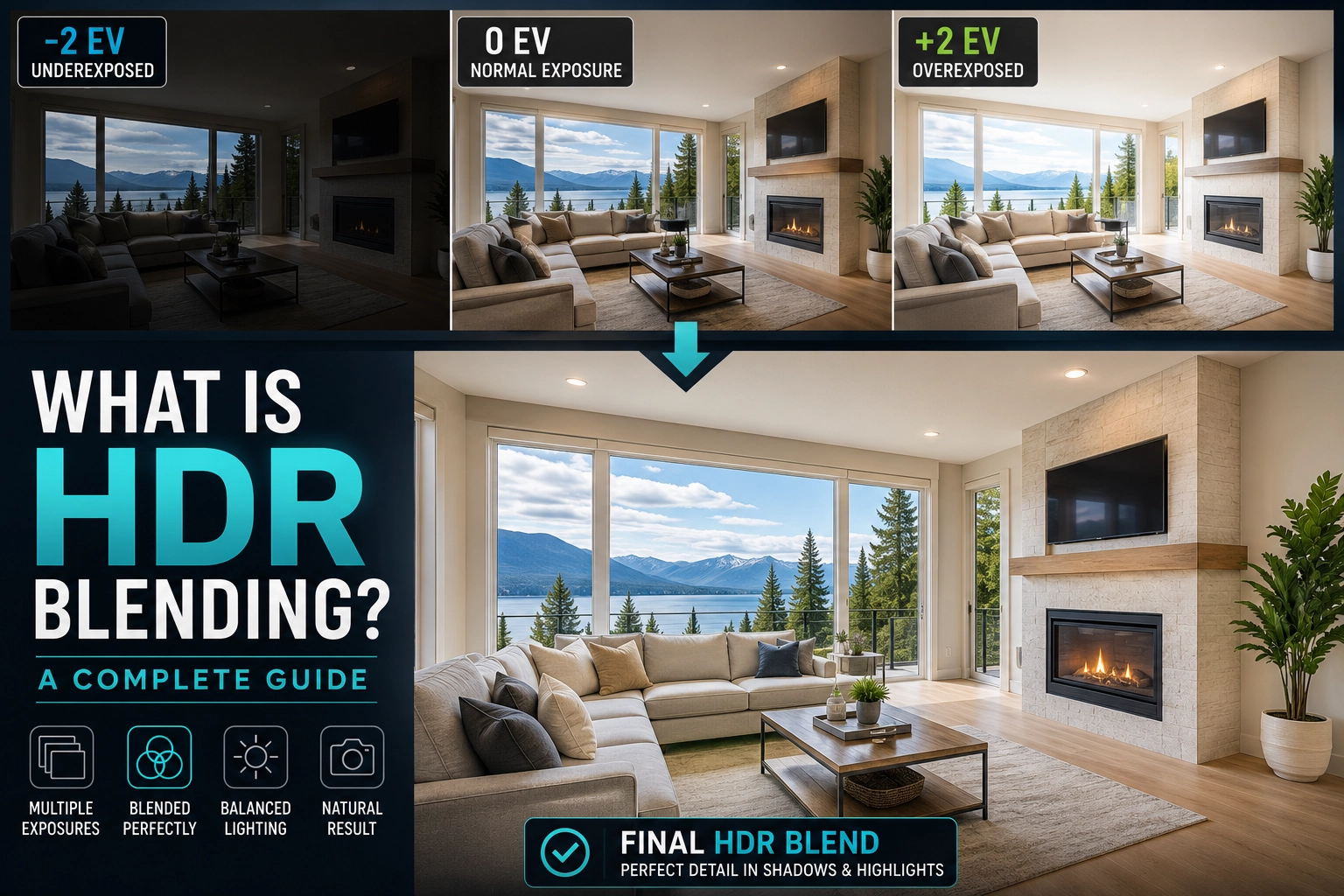
- Underexposed (-2 EV) — preserves detail in bright areas like windows and lights
- Normal (0 EV) — the base exposure for the room
- Overexposed (+2 EV) — reveals detail in shadows and dark corners
Picture a living room shoot: the dark frame shows a perfectly clear window view but a room that’s too dim. The normal frame looks fine indoors but the window is partly blown out. The bright frame recovers all the shadow detail but the window is a total white wash. Blend all three together, and you get one image with a natural interior and a clean, visible window view.
Need more range? Some high-contrast scenes call for 5, 7, or even 9 bracketed exposures (for example, stepping from -4 EV to +4 EV). More frames can recover more detail, but they also add more editing time — which is worth knowing if you’re working to a budget or deadline.
For most real estate jobs, we recommend delivering 3 or 5 bracketed images per composition. That’s the sweet spot most professional real estate photographers shoot, and it gives us everything we need to produce a polished, natural-looking result.
Can We Work With Just One Photo?
Sometimes a bracketed set isn’t available, and that’s okay — we can still help. It’s just important to understand the difference between true HDR blending and single-image recovery.
One JPEG file: Yes, we can work with it, but it’s technically not HDR blending — it’s single-image HDR, exposure balancing, or tone recovery. We can brighten shadows, pull back some highlight detail (if it isn’t fully blown out), and improve overall contrast and color. What we can’t do is pull detail out of a completely clipped white window or a fully black shadow — if the data was never captured, no amount of editing can bring it back.
One RAW file: This gets you noticeably closer to a true HDR result. RAW files hold far more image data than JPEGs, so we can recover more highlight and shadow detail, adjust white balance without degrading quality, and in many scenes produce a result that looks very close to a real HDR blend. The same physical limit still applies, though — completely clipped highlights or shadows with zero recorded data can’t be recovered.
What a Great HDR Blend Should Look Like
The goal is never the dramatic, oversaturated “HDR look” you might associate with amateur photography. A professional real estate HDR blend should have:
- Balanced brightness throughout the room
- Visible detail in both shadows and highlights
- A natural-looking window view
- Accurate, true-to-life colors
- No harsh halos around edges
- A clean, realistic finish that matches what the human eye actually sees
How We Do It
Behind the scenes, our HDR blending workflow typically includes:
- Aligning the bracketed images
- Masking in the best parts of each exposure
- Recovering highlight detail from the darker frames
- Recovering shadow detail from the brighter frames
- Balancing overall exposure
- Correcting white balance and color
- Reducing noise in shadow areas
- Cleaning up any ghosting from movement between shots
- Final contrast adjustments and sharpening
Bring Your Photos to EditMeUp
Whether you’re delivering full bracketed sets, a handful of RAW files, or even single JPEGs, our team can turn your real estate photos into clean, natural, listing-ready images. Bracketed exposures give us the most to work with, but we’ll always tell you honestly what’s achievable with what you’ve got.
Ready to get your next batch edited? Reach out to Editmeup and let’s talk about your project.